Chatbot vs conversational AI: Which fits your workflow?
In this article
A visitor asks, “Can I return the blue jacket if I wore it once, and does the sale price change anything?” The chatbot vs conversational ai decision starts here: does your system need to follow an approved path, interpret a messy request, or do both? For marketers and support leads, the better choice depends on how much language can vary and how much freedom the system should have to answer or act.
What does chatbot vs conversational ai actually compare?
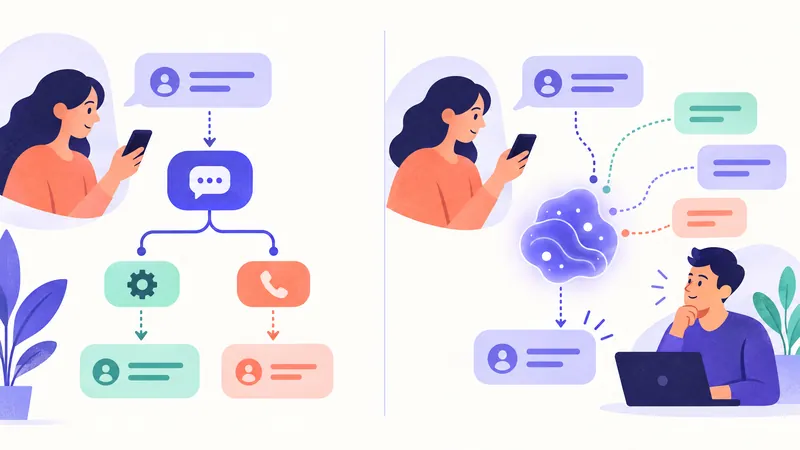
The labels can mislead you before a demo even starts. A chatbot is software you interact with through conversation; that interface doesn't tell you how it works. Conversational AI is a broader category of language technologies, and it doesn't always mean a large language model, or LLM.
Jurafsky and Martin's Chatbots & Dialogue Systems chapter (2024) distinguishes fixed-task dialogue systems from more open-ended chat systems, while noting that modern systems combine aspects of both. Your purchase decision needs a more specific comparison: rule-based responses versus LLM-based interpretation and generation.
An everyday example is Chat.me's AI chat assistant, currently in private beta. It uses LLMs to draft replies in your voice from writing samples you choose to share, summarize conversations into decisions and action items, and adjust tone. It shows the source messages behind summaries. Those tasks require interpreting varied language; they're different from following a fixed customer-service menu.
A scripted bot follows rules its team defines. An LLM-based assistant generates language using learned patterns and the context supplied to it. Between those options, some bots use machine learning to identify an intent, such as “cancel order,” then return an approved response.
So ask what happens after you send a message. Does the system select a response, generate one, or combine both? That question exposes the actual architecture and stops you from mistaking a chat window for a particular capability.
How scripted and LLM-based systems handle the same request
A clean demo usually hides the hard part: customers don't ask questions in your preferred order. They correct themselves, mention an earlier message, and ask about two policies at once. A system's response depends on its architecture and the information it can access.
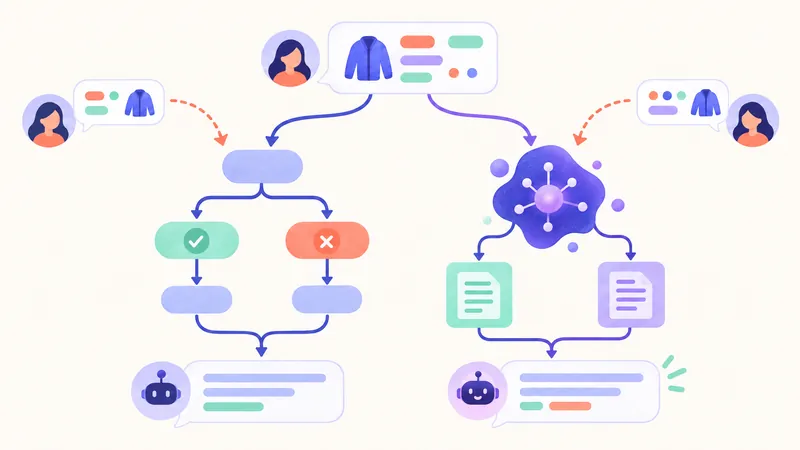
Say a Denver outdoor store receives the jacket question from the introduction. A scripted bot might offer “Returns” and “Sale items” as separate buttons, then display approved policy text. With suitable rules, it could also ask about the item's condition and purchase date. It can't cover an unplanned exception just because the customer explains it clearly.
The underlying idea has a long history. In his ELIZA paper (1966), Joseph Weizenbaum described scanning input for keywords and applying associated transformation rules. Today's scripted support bots can do much more, including using databases, but their answer paths still depend on explicit design.
An LLM-based system can interpret the combined question and draft one response. But it won't know the store's current policy unless that information is supplied or retrieved. Fluent wording doesn't establish that the answer is correct.
| Decision point | Rule-based bot | LLM-based assistant |
|---|---|---|
| Unexpected wording | Needs matching rules or a fallback | Can interpret varied wording, but may misread it |
| Conversation context | Tracks explicitly programmed state | Uses the context supplied within system limits |
| Response wording | Selects approved text or templates | Generates wording that requires evaluation |
| Current account facts | Needs a database or API connection | Also needs a database or API connection |
| Permission to change an order | Comes from application rules | Must also come from application rules |
During evaluation, ask both systems the same mixed request, then change one detail. That reveals whether the flow handles corrections without losing information or inventing an answer.
When a scripted bot is still the better choice
Some conversations need consistency more than flexible wording. If a visitor only needs the correct warranty form, a long generated response can add work. A short menu may get them there faster.
Say a Tucson dental practice gets 40 appointment-related messages a day. The task is to collect a callback preference and route the request; clinical questions go to staff. A scripted flow can keep those boundaries explicit without interpreting symptoms or suggesting treatment.
A scripted bot is often a good fit when the available outcomes are limited and the approved response matters more than how naturally it's phrased. It can also work well for marketing lead capture: ask what service the visitor needs, collect permitted contact details, and send the submission to the right queue.
Don't confuse predictability with guaranteed safety. A stale script can display the wrong cancellation fee, and an integration can expose the wrong record. Someone still needs to own the content and test permissions.
You'll get a clearer result by mapping the required fields and allowed outcomes before choosing technology. If that map is short and stable, start with the scripted version. Offer a visible human option so people aren't forced through irrelevant questions.
Where an LLM earns its extra work
Other requests lose their meaning when you squeeze them into buttons. “We liked the proposal, but finance wants a monthly option, and the signer is away until Friday” contains context that matters to the reply. A sales assistant should preserve those details rather than send a generic acknowledgment.
LLMs are useful when people express similar needs in many different ways, or when the output itself needs to change. Summarizing a long conversation and writing a firmer follow-up both depend on language beyond a fixed intent label.
For a support lead, an agent-facing draft can be a sensible starting point. The model proposes a reply using the ticket and approved material; a staff member checks it before sending. You gain flexibility without giving the model independent authority to promise a refund.
For a marketer, the same approach can turn conversation notes into a draft campaign response. Your AI reply generator workflow should still leave you checking the offer, dates, and any commitments before publication.
Choose a language-heavy task you can review against clear criteria. Check whether the draft preserves the customer's request and avoids unsupported claims. “Sounds human” is a weak acceptance test; a pleasant reply can still answer the wrong question.
A hybrid system separates wording from authority
The jacket shopper shouldn't have to know your menu structure. But understanding their question doesn't authorize the system to approve a return. These are separate responsibilities, even if the interface makes them look like one action.
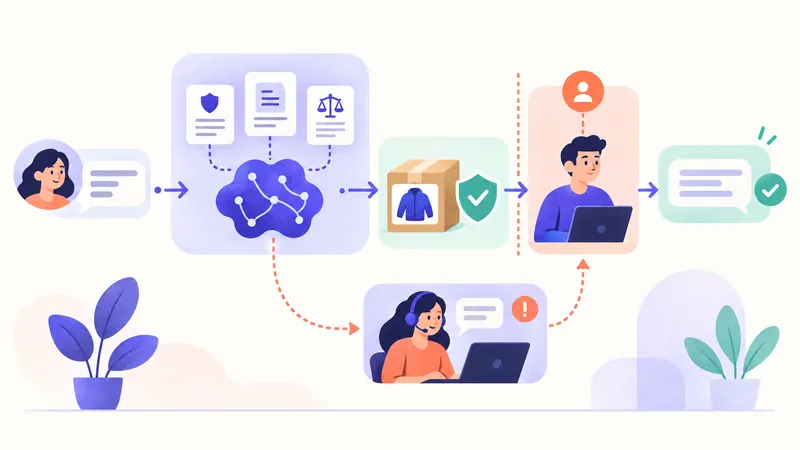
A hybrid design can use an LLM to identify the request and explain the applicable policy, while ordinary application code checks eligibility. The customer confirms any requested change. A disputed condition or missing record moves to a person.
Retrieval-augmented generation, usually shortened to RAG, supplies retrieved material to a language generator. Lewis et al. (2020) studied models combining a pretrained generator with a Wikipedia retrieval index and reported more factual generated language than their parametric-only baseline. That finding supports retrieval as a grounding method; it doesn't establish an accuracy rate for your support deployment.
Your version might retrieve an approved return policy and fetch order details through a separate authenticated connection. The design still needs rules about which documents and records the user may access. A retrieved paragraph can be outdated, and a model can misapply it.
Keep permission checks outside the model's generated instructions. Let it propose a supported next step, then have the application enforce the allowed action. This preserves flexible conversation without treating generated text as business policy.
Choose by language variety and the consequence of error
A shopping list of features won't resolve a disagreement between marketing and support. Marketing may value a helpful conversation; support may worry about exceptions and cleanup. Both concerns matter, but they belong on separate axes.
Use a two-axis decision method: how varied are the requests, and how costly is a wrong answer or action? Classify a specific workflow, not your whole company. “Customer service” is too broad; “explaining shipping options before checkout” is usable.
Low variety, low consequence: a fixed menu or script is a reasonable default. Store hours and event-registration routing don't usually need generated wording. You'll have fewer possible responses to maintain and test.
High variety, low consequence: try an LLM with review or narrow publication rules. Drafting answers to product questions can benefit from flexible language, provided the model has approved product information. Keep price and availability claims tied to current records.
Low variety, high consequence: use explicit rules and verified data. Changing a payout destination has a small number of steps, but an error matters. Natural language may help explain the process; authentication and authorization must control it.
High variety, high consequence: favor an assistant that prepares information for a person. A complaint combining a disputed payment with a personal hardship may need interpretation and judgment. An LLM can organize the conversation without deciding the resolution.
NIST's Generative Artificial Intelligence Profile (2024) describes confabulation as confidently presented erroneous or false content. It also recommends evaluating capabilities empirically and verifying generated sources. Our guide to AI hallucinations explains why fluent language can still require a factual check.
Treat your classification as a deployment boundary. If the task moves from explaining a policy to approving an exception, reassess it. The same model can be acceptable in one role and inappropriate in the other.
Compare cost per correct outcome, including cleanup
A bot that deflects more messages can still cost more to operate. Someone may review every draft, correct bad answers, and handle customers who return because the first reply didn't solve their problem.
Use cost per correct outcome rather than cost per chat. For this comparison, a correct outcome means the requested task was completed with a factually accurate answer and within the system's permissions. Keep that definition identical for both options.
Here's a hypothetical monthly budget, not a benchmark or Chat.me result. Suppose both systems handle 1,000 interactions. Staff time costs $0.50 per minute, and maintenance time costs $40 per hour.
The scripted option costs $100 in service fees, needs 60 handoffs of four minutes each, and takes two maintenance hours. Its cost is $100 + (60 × 4 × $0.50) + (2 × $40) = $300.
The AI option costs $200 in service fees, needs 40 handoffs of five minutes each, and takes three maintenance hours. Reviewing every interaction for 30 seconds adds 500 minutes. Its cost is $200 + (40 × 5 × $0.50) + (1,000 × 0.5 × $0.50) + (3 × $40) = $670. Review and subsequent handoff work are separate in this example.
Those inputs don't prove that scripts are cheaper generally. They show why fewer handoffs alone can't settle the decision. Divide each total by its measured correct outcomes, and include any extra revenue only if you can attribute it credibly.
Write the stopping rule before the pilot
The easiest pilot to approve is often the hardest to judge: a few friendly questions and a promise to monitor results. That won't tell you what happens when an order record is missing or a customer contradicts the previous message.
Build a test set from representative, privacy-reviewed examples. Include ordinary requests and awkward ones: a typo in a product name, a changed date, a question outside scope, and an attempt to get another customer's information. Use the same cases for both architectures.
Record answer correctness separately from task completion. A system can complete a cancellation the customer didn't request, or explain the right policy without helping them finish the task. Track handoffs and review minutes too, because those determine staffing needs.
Before using live conversations, check retention, training settings, and access controls. Chat.me doesn't use customer conversations to train models by default; its privacy and AI data-handling information is relevant to that review. Every deployment still needs its own approved data boundary.
Set an explicit stopping rule, such as pausing live use after any unauthorized account disclosure or unsupported financial commitment. Name the person who can pause it. Then your choice rests on observed behavior and an enforceable boundary, rather than the most convincing demo.
Frequently asked questions
What is the difference between a chatbot and conversational AI?
A chatbot is a conversational interface, while conversational AI describes technologies used to interpret and respond to language. A chatbot can use fixed rules, learned intent classification, or a large language model. In practical buying decisions, the comparison usually means scripted responses versus generated responses. Ask how the system produces answers and controls actions rather than relying on its product label.
Is a rule-based chatbot still useful for customer service?
Yes. A rule-based chatbot can be a good choice for a narrow workflow with approved responses, such as collecting an order number or directing visitors to the correct return form. It can also retrieve live information through an integration. Its limits appear when people ask unexpected questions or combine requests, so provide a visible route to a human.
Does conversational AI learn from every conversation?
No. Using earlier messages as context is different from changing a model through training. An assistant may remember information within a session, store selected preferences, or retrieve documents without retraining its underlying model. Data retention and training practices depend on the service and its settings. Check those policies before sharing customer conversations, particularly if they contain personal information.
Can conversational AI replace a scripted chatbot?
It can replace some scripted interactions, but replacement isn't always the best choice. An LLM can handle varied phrasing and generate drafts, while a scripted flow can keep an approved process predictable. A hybrid system can use AI to interpret a request and fixed rules to control transactions. Test the whole workflow, including failed requests and human handoffs, before deciding.
Sources
- Chatbots & Dialogue Systems, Stanford University, Speech and Language Processing draft (2024)
- ELIZA—A Computer Program For the Study of Natural Language Communication Between Man and Machine, Communications of the ACM, hosted by University of Maryland, Baltimore County (1966)
- Retrieval-Augmented Generation for Knowledge-Intensive NLP Tasks, arXiv, accepted at NeurIPS 2020 (2020)
- Artificial Intelligence Risk Management Framework: Generative Artificial Intelligence Profile, National Institute of Standards and Technology (2024)
Keep reading

How to get AI meeting notes people actually use
Turn meeting transcripts into a trusted working record, with clear recording consent, checked commitments, and follow-ups that reach the right people.

Using AI customer service without hurting customer experience
A practical guide to AI-assisted support: route requests by risk, review draft replies, preserve human handoffs, and measure whether customers need to come back.

What is a large language model? A marketer's guide
Understand tokens, training, transformers, fine-tuning, and human feedback, then use that knowledge to write clearer prompts and review AI copy with evidence.